
THE DISPOSITION TOWARD GROWTH AND EXPANSION
The pretense of the automated landscapes as closed-system links to the design of their active form, i.e. the spatial organizations, providing information about their disposition or the unstated activities of these systems, as defined by Keller Easterling.[14] The seemingly isolational nature of these landscapes contrasts sharply with what they are actually doing, as their innate active forms propagate these systems toward exponential growth and replication. The resources for this kind of growth are provided by the upper hand gained due to both the previously mentioned rapid speed and various active form elements.
Easterling suggests defined indicators -i.e. ‘multipliers‘, ‘wiring‘ and ‘governors‘- that are parts of the active form marking the dispositions within these systems and illustrating their embeddedness within larger systems. The most utilized of these markers within the automated landscapes are the multipliers, which have the power to rewire the space. They can expose how these systems‘ spread and amplify their effects beyond their boundaries, referring both to the microscales and to whole landscapes themselves, which may possess the ability to be replicated in space.[15] The multipliers could be considered the main propellers for the expansion and the future takeover by these landscapes, with the proof being Kiva Systems robotics and other automated guided vehicles.[16]
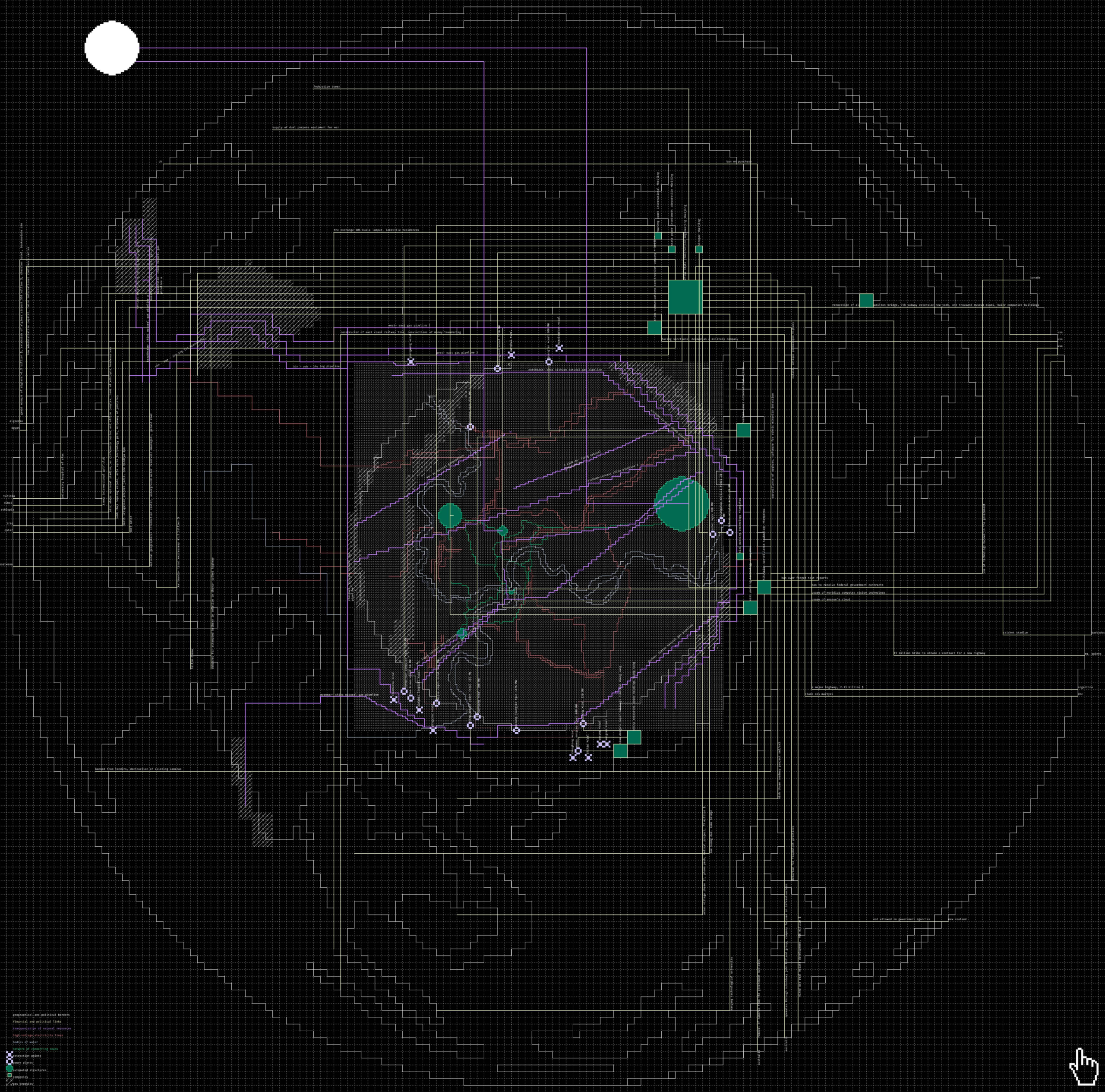
The encompassing wiring or topology grounds these spaces in their surroundings. Although automated systems may appear stable and formulaic, they are subject to the unpredictability inherent in their networks. A failure in one node of a network (a server, an energy source, an input or output point) can lead to far-reaching effects that disrupt the entire system. Even though a high level of redundancy is provided, the possibility of a flaw is always present due to the extreme interdependencies. The network exposes the interconnectivity of the system, where changes, vulnerabilities and influences are constantly in flux, and any pretense of a closed system is illusory.
The ‘Governors‘ in Easterling’s analysis refer to the regulatory or controlling forces in the systems—be they formal laws, informal rules or algorithmic protocols—that establish the relations between the participants of space that are managing the ongoing actions, with the leading goal being the aforementioned uninterrupted acceleration and growth.[17] Automated systems often portray themselves as autonomous or self-governing through the application of algorithms, artificial intelligence and machine learning, while in reality the governing protocols are established as a part of the milieu and are vulnerable to regulations, financial pressures, political interests and human design. The programming for ongoing actions within the automated landscapes is inherently dependent on the subjective data sets from the outside of the system or on the types of sensors or on the modes of perception within them, which further influence the ongoing processes.