
PROGRAM
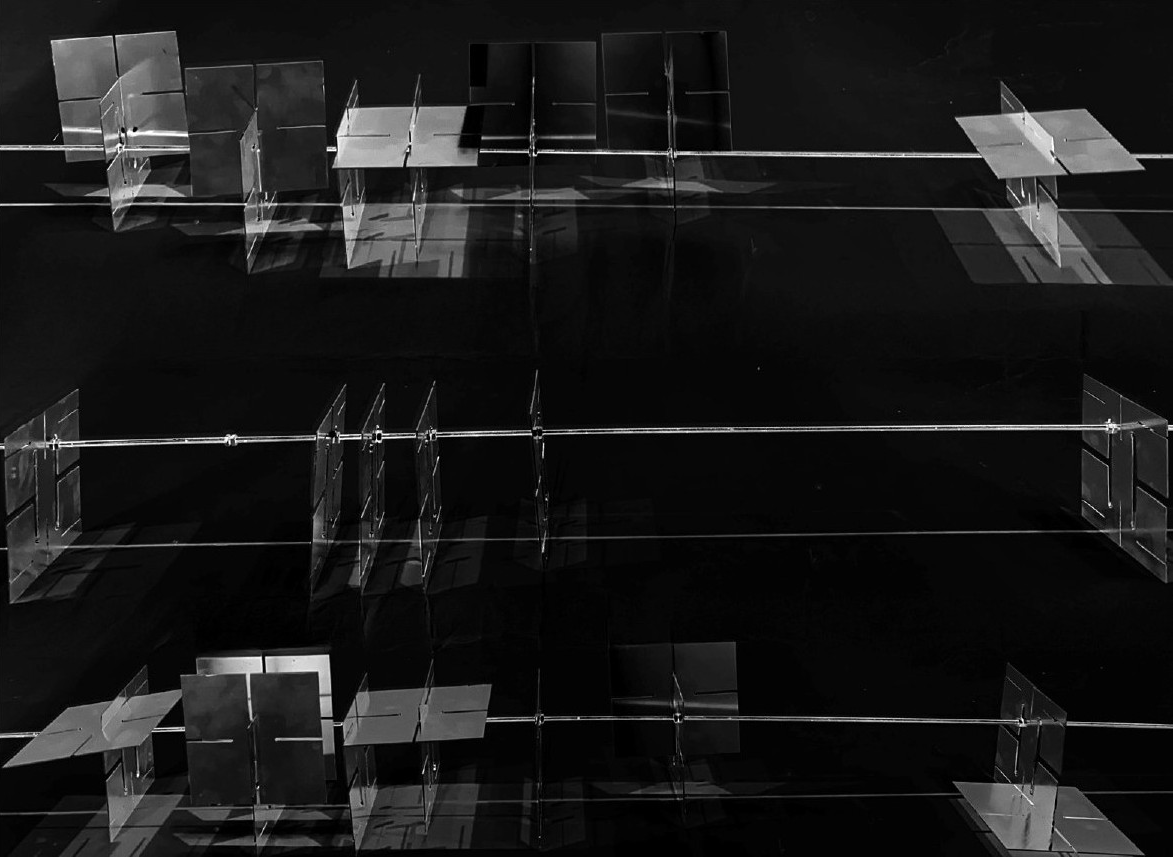
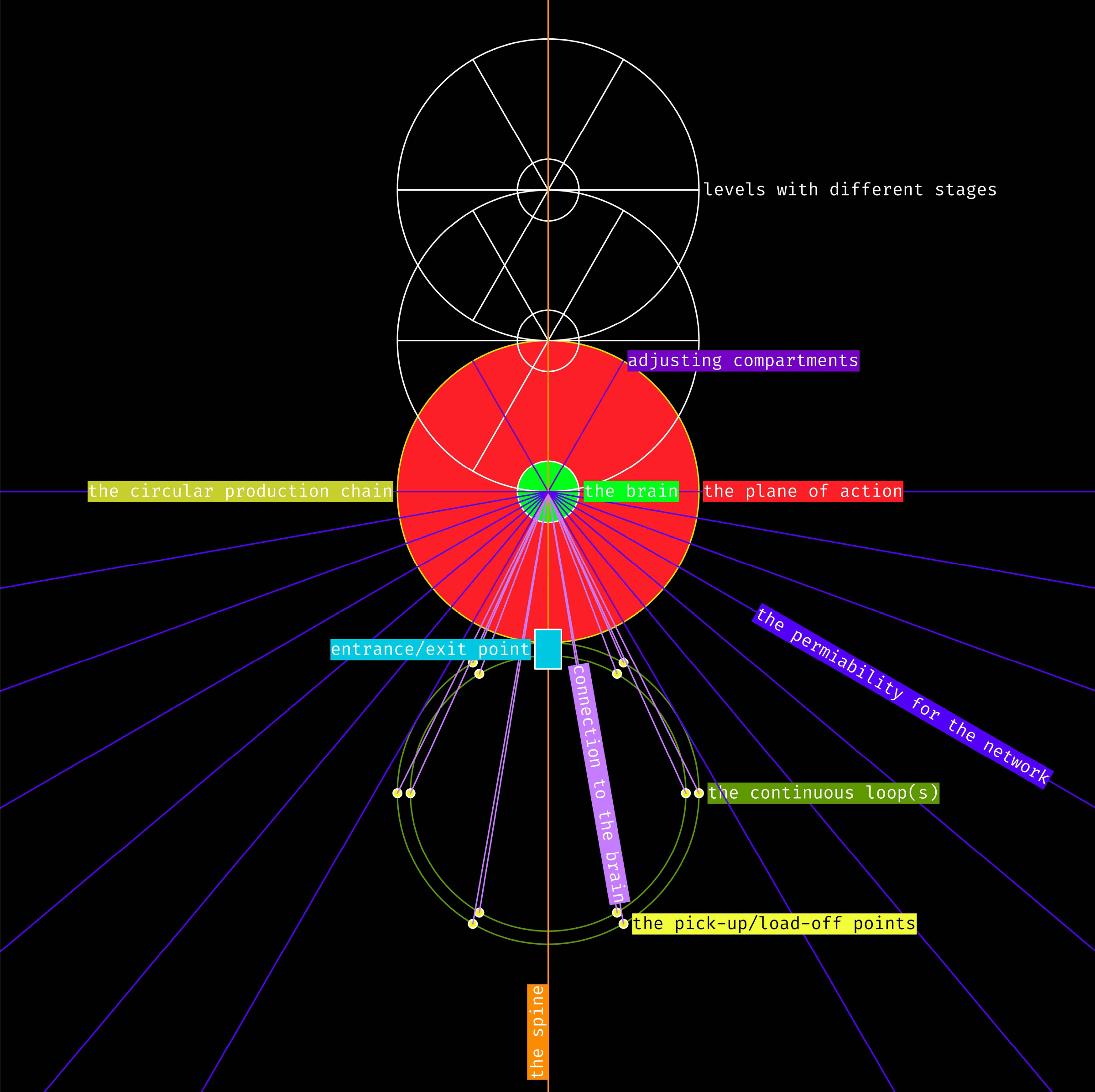
The main requirement in creating an idealized space of automated organisation was the reconfigurability of the space, creating as many spatial variations as possible from one axis and two types of elements. The primary plane possesses the ability to be rotated and moved along the axis, while the secondary planes can be additionally arranged intersectionally, creating versions of extended, closed and partially open space. This main axis would not only facilitate the movement but also be inherently connected to the previously mentioned networks and provide the connection between various floors, linking back to the principles of managerial cybernetics (as defined by Stafford Beer), where the sympathetic nervous system connects the portion of the systems that carries out the operations, with the computational part.
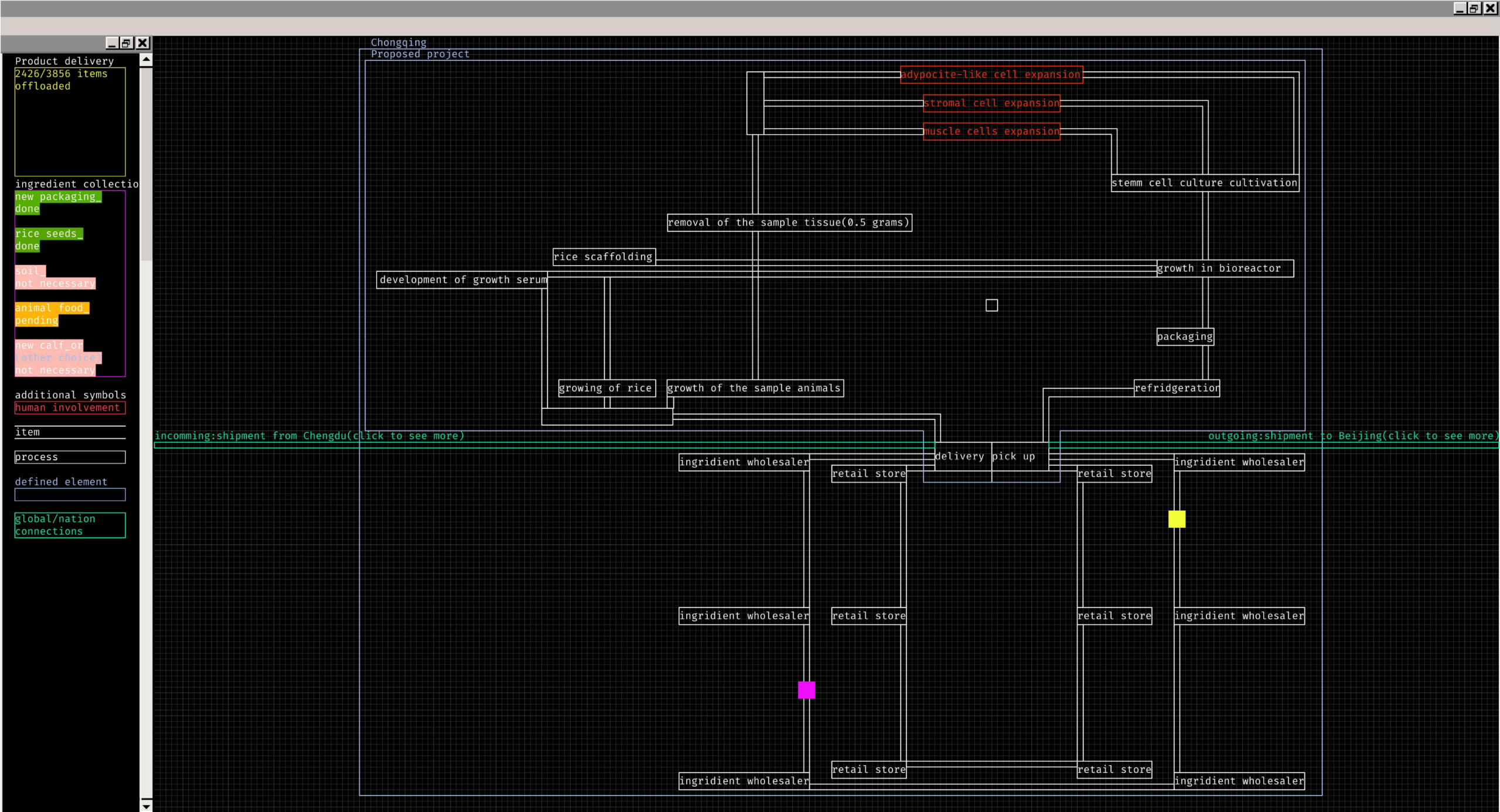
The model and principles of absolute efficiency can be translated back to a 2D drawing. The production chain becomes a production loop, unfolding in a perpetual motion. The entry and exit points are organized in the same location, making the process of the exchange of elements as productive as possible.
This point of interchange is also connected to the ingredient retrieval and distribution loops in the city, with vehicles carrying out product delivery to stores and ingredients being constantly retrieved. The high level of automation would eradicate the need for distribution centers, responding to demand statistics and predicting certain patterns.
The reconfigurability of the system, where the mechanics can move and adjust in real-time, would support a large part of a production chain, with the space of each of the operations being adjusted according to input from sensors. The sensitivity, quick adaptation time and high precision call for use where a fast response is necessary for the monitoring of processes, with the additional benefit being the allowance of growth, as spaces would be adjusted according to expansion. The automated organization of elements can be applied across various scales, starting at the molecular level, playing a crucial role in chemical manufacturing, biotechnology and food production.
Research published by a group of scholars from the Massachusetts Institute of Technology in 2022[21] proposes that the development of synthetic meat would benefit greatly from implementing the principles of automation, as the cultured meat development will likely involve a continuous, automated bioprocess with real-time monitoring, minimizing operational costs and contamination risks. It also ties together with the fact that synthetic meat and related technologies have been determined as key investment areas in China’s 14th five-year plan (2021-2025), indicating the first occurrence of alternative proteins mentioned in any government’s economic development guidelines.
Artificial meat development, although constituted as food production, involves the sorting of ingredients with laboratory-like precision. Sample tissue is taken from an animal and combined with the growth medium, after which the cells are cultivated in a biological reactor. The speed at which the meat is developed aligns with the acceleration principles, as the cells mature in 2 weeks instead of 2 years, which would usually take for cattle to mature. All this is carried out in a highly controlled environment because the cells themself do not have an immune system, justifying the high level of separation between the inner workings and the outside world at specific parts of the proposed structure, permitting the interaction only at established points. Elsewhere, where there is a need for the delivery of ingredients and collection of finished products to be carried out with no obstructions, the access should be designed to permit the maximum possible momentum. Such an approach would create outside-inside spaces or separate the structure with a building envelope only where it is strictly required.