
OFFICE FOR DIGITAL OBLIVION
The Office for Digital Oblivion aims to re-ground discourse on information technologies and the realm of the digital through engagement with its immediate material conditions and operations. It has grown to become a full-fledged hybrid, blurring boundaries of what we consider natural or cultural, ecological or anthropocentric. It aims to challenge perceived banalities around information infrastructures, tracing systems through scales and aiming to spatialise and thus problematise operational complexities which due to their scale remain largely illegible. With that, it puts forward new approaches to conceive of infrastructural systems, transgressing purely technocratic dogmas and proposes new ways of thinking, worlding and becoming-together in the Anthropocene.

As discussed above, our digital data and the realm of the ‘online’ turn out worryingly fragile for something so crucial to many aspects of our contemporary worlds. Our data is dependent on highly complex assemblages of technological systems that are increasingly vulnerable to various types of disturbances, disruptions and thus loss of information. In light of this, despite a digitalisation at a breathtaking pace, the concept of ‘air-gapped-backups’ has seen significant widespread adoption. Here, the valuable information is stored on various media such as tapes or optical discs off the grid to prevent loss and destruction.

Taking this imperative as a point of departure, the Office for Digital Oblivion is a proposed institution whose core objective becomes the collection, selection and storage of valuable information, currently existing online on offline storage devices, initially optical discs, preserving humanity’s largest cultural commons – the Internet – for the future.
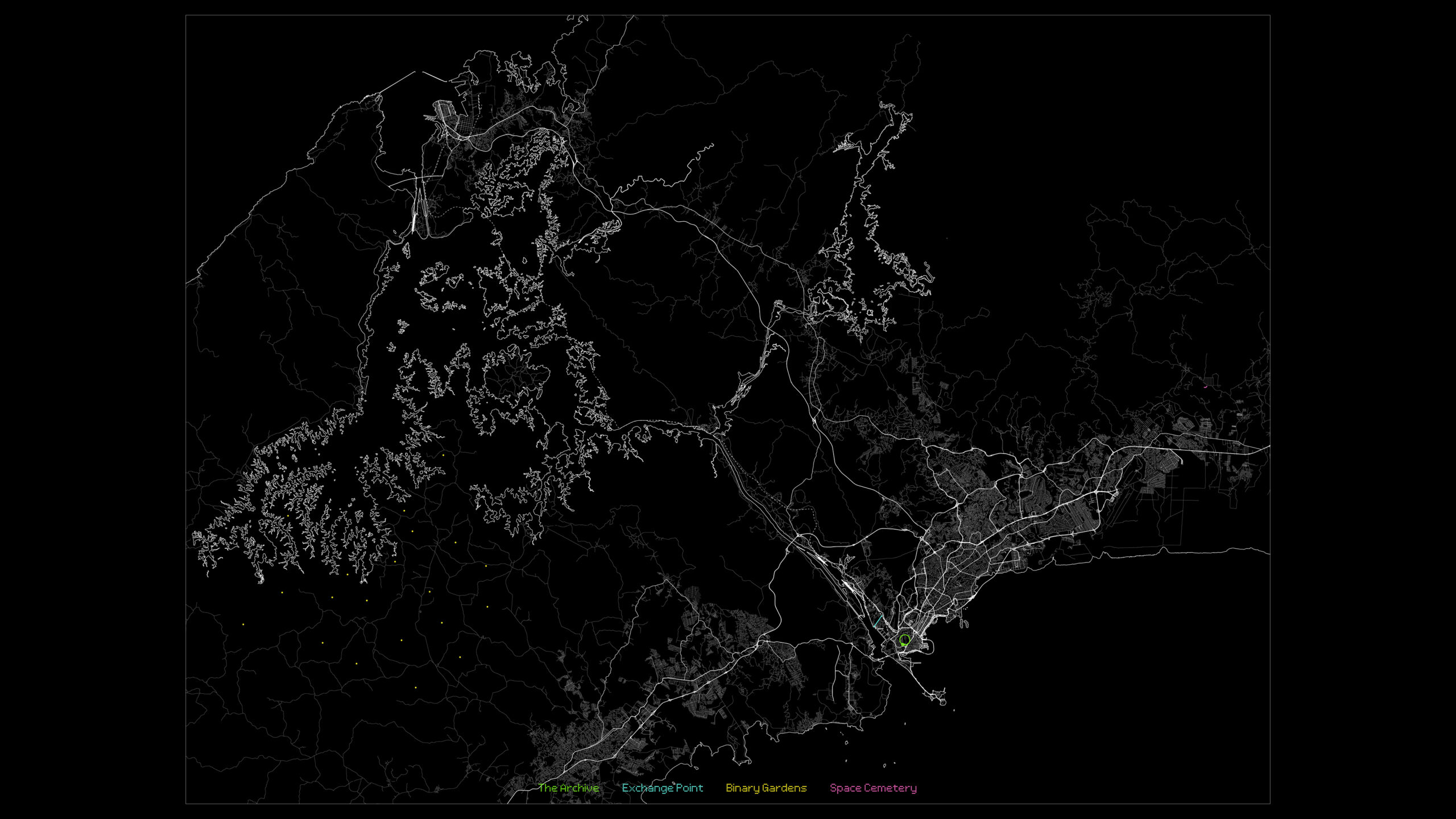
In its territorialisation, the project grafts itself upon a strategic constellation of zonefacts. The Archive makes use of a former bunker and antenna array on Ancon Hill; The Exchange Point is located at the former military communications hub and contemporary Cable Landing Station in Corozal; The Binary Gardens spread through the deforested landscapes south of Lake Gatun and The Space Cemetery sits at the satellite ground station in Utivé. The parts work collectively, complementing each other’s operations, connected through material and informational flows.